Since I grew up in Canada, I am a huge hockey fan. My team is the Vancouver Canucks and I have been a die-hard Canucklehead since I was a wee one (and it has mostly been die-hard with them over all those years). The team I can’t stand the most (for various reasons I won’t delve into) is the Detroit Red Wings, and of course, they just won the Cup over Pittsburgh.
The only good thing about this is that Dallas Drake plays for the Red Wings. Dallas is from my hometown of Rossland, British Columbia, and I actually played minor hockey with him in Rossland many many moons ago. Dallas is the first Rosslander to ever win the Stanley Cup (and actually, the first Rosslander ever to even play in the NHL), so it is pretty cool that he won it. These days, Dallas is a hard-working, hard-hitting, checker on the Wings and doesn’t score much (and he does his job very well). But back in the old days, Dallas was one of the play-making stars of our team, and could turn any opposing goalie inside out and upside down. We actually had quite a few great players on our team, and others that perhaps could have made it in the NHL as well (excluding myself). But Dallas was the only one who was determined enough to make it. So congratulations Dallas! This was well-earned, and all of Rossland is excited for you.
Posted in Uncategorized by leapin26: June 4, 2008
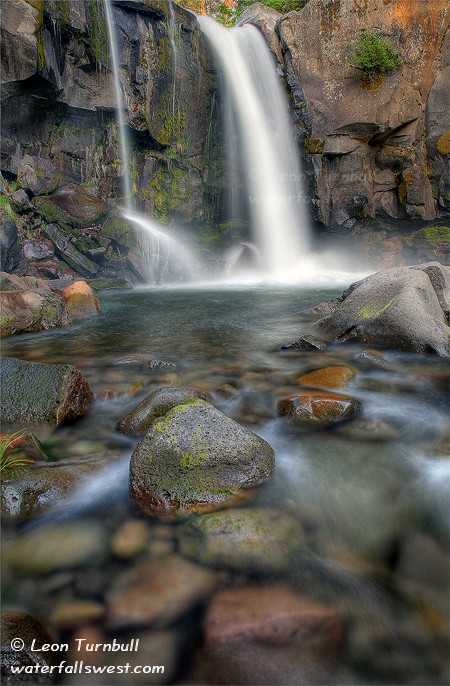
I was back up north again this past weekend because I had to go back to my father-in-law the dentist again (part 2 of 3). It was Sunday evening, and I met up with my friend Brian again to go out shooting. We didn’t really have too much time before dark, but I had heard of a lower waterfall on Battle Creek near Mineral, and thought we might have time to try finding it before dark. I kinda had my doubts though. The person who told me about it said it was about a mile scramble downstream on the creek. I figured we might be hiking back in the dark. But Brian was game so we went for it.
When we arrived at the creek, we started hiking down the south side of Battle Creek. The going was very easy. After a short while though, the road we were following started heading up and away from the creek. We figured we’d better find a way down to the creekside, and so we found a steep path leading down, and scrambled and tumbled down the bank to the creek. Once down at the creek, we realized we were at the top of the very waterfall that we were looking for! It wasn’t a mile downstream, but only about a quarter mile. And it was a dandy of a waterfall, 30 ft. high, plunging off a steep cliff into a fabulous pool below. But we quickly realized we were on the wrong side of the creek. There was no way down to the bottom from the south side of Battle Creek. But it looked like there was a path, albeit a steep one, on the other side, where we could get down to the bottom of the falls. But how to get there? We started going back upstream of the waterfall, looking for a way across the creek. The creek was flowing pretty strong and deep but we found a potential spot. I got on my water shoes, and Brian got on his bare feet. And thus, we forded across the creek. It was almost waist high at the deepest point. I was crossing very tentatively because I was afraid of slipping and drowning my camera. But I finally made it across. I looked back and Brian (in his bare feet) came whipping up quickly behind me like it was no big deal. It must be because he is so much taller than me (or something). Anyway, we got our hiking boots back on and went back downstream, and down the path to the bottom of the falls. It was quite steep, but it was do-able. And it was really a fabulous waterfall. I was very pleased, and especially, that it was not too difficult to reach. (and more importantly, that we wouldn’t be hiking back in the dark). We both got back on our water shoes (or bare feet, in Brian’s case) and promptly got back in the water for picture taking.
On the return trip, we stayed on the north side of the creek, where there was a nice little trail leading all the way back to the bridge at the campground. Easy as pie! Along the way, we came across a grave stone, for some one named Steven Callahan (or something like that). I guess maybe it was some kid who died here, maybe going over the waterfall. Who knows.
Posted in Uncategorized by leapin26: June 3, 2008
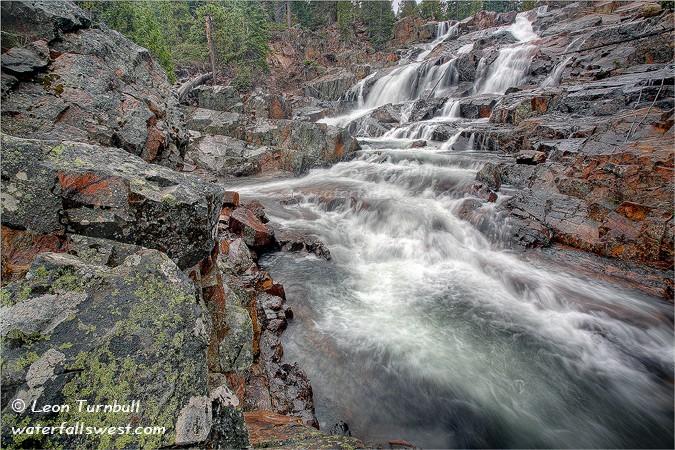
Lower Glen Alpine Falls is a very intriguing 65 ft. high waterfall just above Fallen Leaf Lake. I love how it steps down the rocks in such a neat fashion before it continues chugging on down through a scenic little canyon into Fallen Leaf Lake. Aussie Neal liked it too. I brought him here after we photographed Fallen Leaf Lake. He had not known about this waterfall before, and I think he was thoroughly impressed with it. Well hey, glad to be of service Neal. That’s what I’m here for. Too bad we didn’t have more time though. I could’ve shown you plenty of other waterfalls too.
It was nice that it was overcast this day, which is the perfect type of day for photographing waterfalls. No harsh sun, nice even lighting. It is also somewhat nice that you can drive right up to this one. The bad part about this waterfall is all the houses around. You have to take care a bit to keep some of them out of the camera’s view point. I guess it would be nice to live there, overlooking the waterfall in your own backyard. But it doesn’t make for much of a waterfall wilderness experience.
Posted in Uncategorized by leapin26: June 1, 2008

Well this lake sure looks a lot different on a cloudy, overcast, and drizzly day. Fallen Leaf Lake is one of the lakes I love to come to at sunrise to catch the first light on towering Mt. Tallac. On this day though, Tallac refused to show her face, choosing instead to cover herself up behind the clouds. She’s just too finicky, I guess. What can you do. Well, take a picture anyway, that’s what. The clouds covering the mountains do make for a different, and rather interesting scene, with Fallen Leaf Lake in the foreground.
Posted in Uncategorized by leapin26: May 29, 2008

Neal, a photographer friend of mine from Australia, was visiting Lake Tahoe on vacation this past weekend, so I met up with him there for a morning photo shoot. He wanted to get that awesome sunrise shot overlooking Emerald Bay with some amazing colorful puffy clouds, just as the sun rises over the distant horizon. Yeah, right. God had other plans this weekend. It was overcast and rainy. The sun did not make an appearance all day, and hardly at all throughout the weekend. I feel bad for poor Neal. He comes all the way from Australia to Lake Tahoe, and has crummy weather all weekend. Apparently, he didn’t fare much better in San Francisco earlier in the week either. Ah well, it is really all his fault anyway, for bringing all that bad weather over here from Australia. 😉
Well, it wasn’t all that bad really. We had a fun time together this morning, shooting at three different locations. It was overcast, as you can tell from the photo, and the rain was just drizzling for the most part, so it wasn’t awful at all. This shot was taken from the brink of the falls (obviously) overlooking the Bay, just around sunrise. Can’t you see all the beautiful sunshine? 🙂 Neal was a bit antsy (and rightfully so) about getting too close to the edge of the waterfall. I think he thought I was much too close for comfort, though i didn’t feel that I was in an unsafe position whatsoever. Standing at the edge of Eagle Falls doesn’t bother me as it would at certain other waterfalls (at Bassi Falls, for eg., I would be totally freaked out standing this close to the edge).
Posted in Uncategorized by leapin26: May 27, 2008